
Start here
- Open the report for the completed battle.
- Compare the wall phase with the garrison phase.
- Read losses and survivors before ordering another attack.
Common mistake: Total attack power cannot all fight soldiers: the wall absorbs power first.
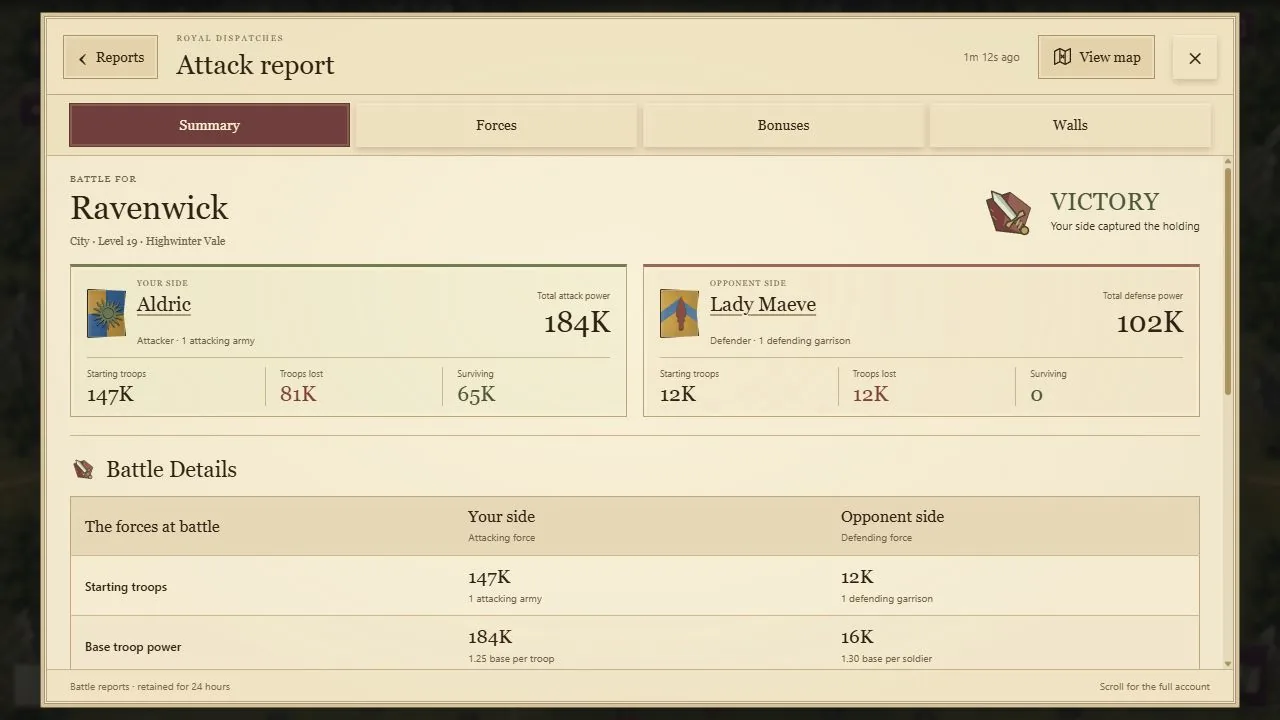
- 1The outcome states whether the holding changed hands.
- 2Losses and survivors explain the cost of the result.
- 3The Walls section isolates the first siege phase.
Select the image, then choose View full size to inspect details. Scroll or swipe inside the enlarged image.
Start with the two questions at the top
The side-by-side summary answers the two most important questions first: how much attack power arrived, and how much resolved defense stood against it? Troop totals are still shown, but raw troop counts do not decide a siege by themselves. The attacker's hero skills are locked into the army when it launches. The defender's soldiers, reinforcements, objective support, and wall condition remain live until arrival.
Next compare starting troops with survivors. A capture requires the attack to breach the wall and then exceed the garrison defense with the power that remains. That is why an army can have more total power than the soldiers behind the wall and still fail: the wall may absorb the difference before the garrison phase begins.
Attacker power is fixed at launch
Every attacking troop begins with 1.25 attack power. Swordmastery adds two percent per level, up to 100%, which gives 2.50 skill-only attack power per troop. Equipped attack gear adds against the same base, subject to the combined +200% attack-bonus cap. New rallies receive no Training Grounds bonus. The report lists those contributions separately instead of hiding them inside one multiplier.
Swipe across the table to see every column.
| Report line | What it means | Question to ask |
|---|---|---|
| Base attack | Troops multiplied by the universal 1.25 starting power. | Was the army large enough before bonuses? |
| Swordmastery | The attack skill captured when the march launched. | Would a different preset have changed the threshold? |
| Equipped attack gear | Attack effects captured with the launch. | Was the intended sword equipped before dispatch? |
| Total attack power | The sum carried into wall and garrison resolution. | How much reached the holding compared with the forecast? |
Defense has one wall and one combined garrison
Every defending soldier begins with 1.30 defense power. Shieldwall Discipline adds 3% per point, reaching 100% at 34 points. A Defense Stronghold or Crown Citadel effect strengthens eligible defending soldiers; it does not increase wall power. City level never strengthens an individual soldier.
The holding has one physical wall. Stoneworks is the only skill that increases that wall. Allied reinforcements add soldiers and the sender's applicable live soldier-defense package to the garrison, but they do not create another wall or another Stoneworks layer. The report therefore shows the owner and every contributing ally while retaining one wall result.
Wall layer
- Based on holding level and current integrity.
- Modified by Stoneworks and applicable equipped wall gear.
- Absorbs attack before the garrison fights.
- Can remain damaged after a meaningful hit.
Garrison layer
- Owner troops plus allied reinforcements.
- Uses 1.30 base defense per soldier.
- Uses Shieldwall and eligible objective support.
- Fights only after attack power breaches the wall.
The wall result explains where the attack stopped
Wall integrity before battle tells you how much of the holding's full wall was available when the army arrived. The report then shows damage and remaining integrity. When the wall holds, it absorbs the assault and defender troop losses are capped at ten percent. If it breaks, remaining attack power continues into the garrison phase.
A hit must remove at least five percent of full wall power to persist. Persistent damage adds the same share of the holding's full-breach repair window to the active deadline. The base full window is fifteen minutes plus 0.3 minutes per city level, rounded to the nearest minute. Applicable equipped repair gear can reduce new regular-city repair time by up to 50%; existing deadlines keep their recorded timing. Repairs restore integrity continuously, and later meaningful hits preserve elapsed progress while adding only their own proportional time.
Ownership changes do not magically repair a wall. Combat captures, relinquishment, neutralization, and capture level drops preserve the current integrity and deadline. This creates a genuine counterattack window: the new owner may hold the city, but the report can reveal that the inherited wall is still vulnerable.
Separate survivors, losses, and returned troops
“Survivors” are the troops that remained after the battle calculation. “Lost” is the amount removed in combat. Field Medics can return a percentage of eligible attacker losses after the battle, and the report lists that recovery separately so it is not confused with surviving the fight.
Experience is also reported separately from troops. A failed attack can still produce reduced experience, while a capture reflects the larger accomplishment. The useful strategic measure is not simply whether experience increased; it is whether the territory, wall damage, intelligence, or pressure created by the march justified the production time that was consumed.
Use forecast changes as evidence, not excuses
A forecast is created from the latest successful intelligence. The attacker's per-troop power is fixed at launch, but the target remains active. Troops may be produced, allied reinforcements may arrive, a damaged wall may repair, objective ownership may change, or the holding itself may change owners.
The battle report lets you compare the launch forecast with the arrival state. If a predicted capture became a defeat, look for the changed component rather than assuming the calculation was random. Report age, wall integrity, reinforcements, garrison size, and live objective support are the most common explanations.
What the simulated battle teaches
This capture shows the actual game report for a simulated attack on Ravenwick. Crownlands' combat calculation produces about 184,000 attack power against 102,000 defense. Roughly 147,000 troops begin the attack and 65,000 survive; the defending garrison is defeated.
The victory has a substantial cost. Compare the power totals, then the lost and surviving troops. Open Walls to separate the wall phase from the garrison fight. The names, ownership and forces are fictional demonstration state; the interface and combat calculation come from the September 20 capture build.
Five checks before the next attack
- Confirm the successful scout report is still inside its ten-minute intelligence window.
- Compare the wall requirement and garrison requirement separately.
- Check whether inbound reinforcements or repair time could change the target before arrival.
- Leave a defensive reserve at the source instead of treating the attack as an isolated calculation.
- After arrival, read every changed line before repeating the same march.