
Start here
- Scout the intended target.
- Check intelligence age, wall, troops, and reinforcement details.
- Compare travel time with how long the intelligence remains fresh.
Common mistake: A forecast is not a guarantee: defenders and walls can change before arrival.
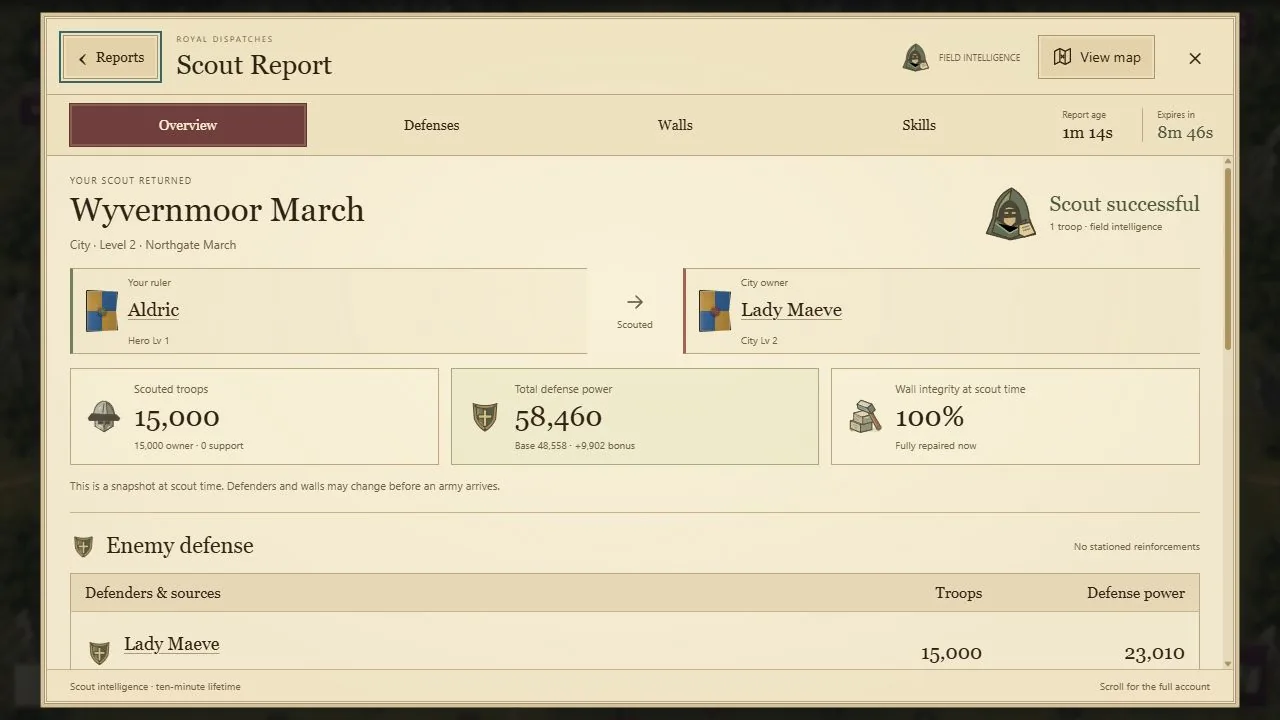
- 1Read the age and remaining intelligence time.
- 2Defense power and troops are separate readouts.
- 3Wall integrity is a snapshot taken when the scout arrived.
Select the image, then choose View full size to inspect details. Scroll or swipe inside the enlarged image.
Successful intelligence lasts ten minutes
A scout is a one-troop march that resolves after it reaches the target. A successful result creates target-specific intelligence in Reports. That intelligence remains current for ten minutes from arrival and then disappears. A newer successful scout against the same target replaces the older report and starts a fresh timer.
A failed, blocked, or otherwise unsuccessful scout does not refresh the existing intelligence. This prevents repeated invalid orders from keeping a target permanently visible. Attack and defense reports follow a different lifecycle and remain available for twenty-four hours after combat.
Scouting separates the holding into useful parts
The report identifies the owner, stationed garrison, each allied reinforcement contribution, current wall integrity, wall power, garrison defense, and applicable skills or objective support. Those details let you identify what could change before arrival.
Swipe across the table to see every column.
| Intelligence | Why it matters | How it can change |
|---|---|---|
| Wall integrity | Determines how much attack is absorbed before soldiers fight. | Repairs continuously or falls after another meaningful hit. |
| Owner troops | Forms the primary garrison. | Production, outgoing marches, and regrouping continue. |
| Reinforcements | Add allied soldiers and applicable defense packages. | New support may arrive; existing support may be recalled or dismissed. |
| Objective support | Can strengthen eligible defending soldiers. | Stronghold or Citadel control can change. |
| Protection | Can turn a capture attempt into a protected outcome. | Protection may begin, expire, or be removed by player action. |
Read the capture threshold in two phases
The forecast first estimates how much attack power the wall will absorb. If projected attack cannot breach it, the likely result is a wall hold. If attack breaches the wall but the remaining power cannot exceed the garrison, the likely result is a garrison hold. A likely capture requires both conditions to be satisfied.
The interface labels projected losses, estimated survivors, capture power, and any shortfall. Advantage labels are conservative: “Overwhelming” requires at least three times the resolved defense. Use that wording as a communication aid, not as a substitute for the actual numbers.
Safer signal
The threshold is comfortably exceeded after accounting for the wall, travel time is short, and no inbound defense is visible.
Fragile signal
The threshold is barely exceeded, the wall is repairing, the target belongs to an active clan, or the army crosses several regions.
The attacker locks; the defender keeps moving
The attacking army's per-troop power is fixed when the march launches. Swordmastery and eligible attack support are captured with it. Editing a skill build in transit does not change that order.
Defense is resolved at arrival. The target may produce more troops, receive reinforcements, repair its wall, change objective support, gain or lose protection, or change owners. The server also validates the live route and target state. A forecast that later differs from the battle result is therefore evidence that the world changed, not evidence that the earlier snapshot was meaningless.
This asymmetry creates real strategy. The attacker can rely on the strength already committed; the defender can react through the systems still available before arrival.
Time pressure around walls and travel
A damaged wall creates an opportunity only if the army can arrive before enough integrity returns. Base full-breach repair time equals fifteen minutes plus 0.3 minutes per city level, rounded to the nearest minute. Applicable repair gear may shorten a new regular-city repair deadline; use the recorded timer. A partial meaningful hit adds only its share of that time, and the wall recovers continuously.
Compare three clocks: the report's ten-minute life, your army's travel time, and the target wall's remaining repair time. If travel exceeds the intelligence window, consider a second scout timed to arrive closer to the army. If the wall will recover before the attack, use the forecast with the expected recovered value rather than today's damage percentage.
Clan coordination adds a fourth clock: reinforcement travel. A defender may have less time to gather support than the attacker has to cross the map, but a nearby clanmate can still change the garrison quickly.
Six scouting mistakes to avoid
- Reading the number over a city as its complete defense.
- Launching from an old report without checking its remaining intelligence time.
- Comparing total attack with garrison defense while ignoring the wall.
- Assuming a damaged wall pauses its repair while you decide.
- Forgetting that allied reinforcements use live defense packages at arrival.
- Sending every troop because the target looks weak and leaving the source exposed.