
Start here
- Agree on a valid objective with your clan.
- Contribute from an eligible source and travel to assembly.
- Check readiness and incoming contributions before launch.
Common mistake: Troops on the way are not the same as troops ready at assembly.
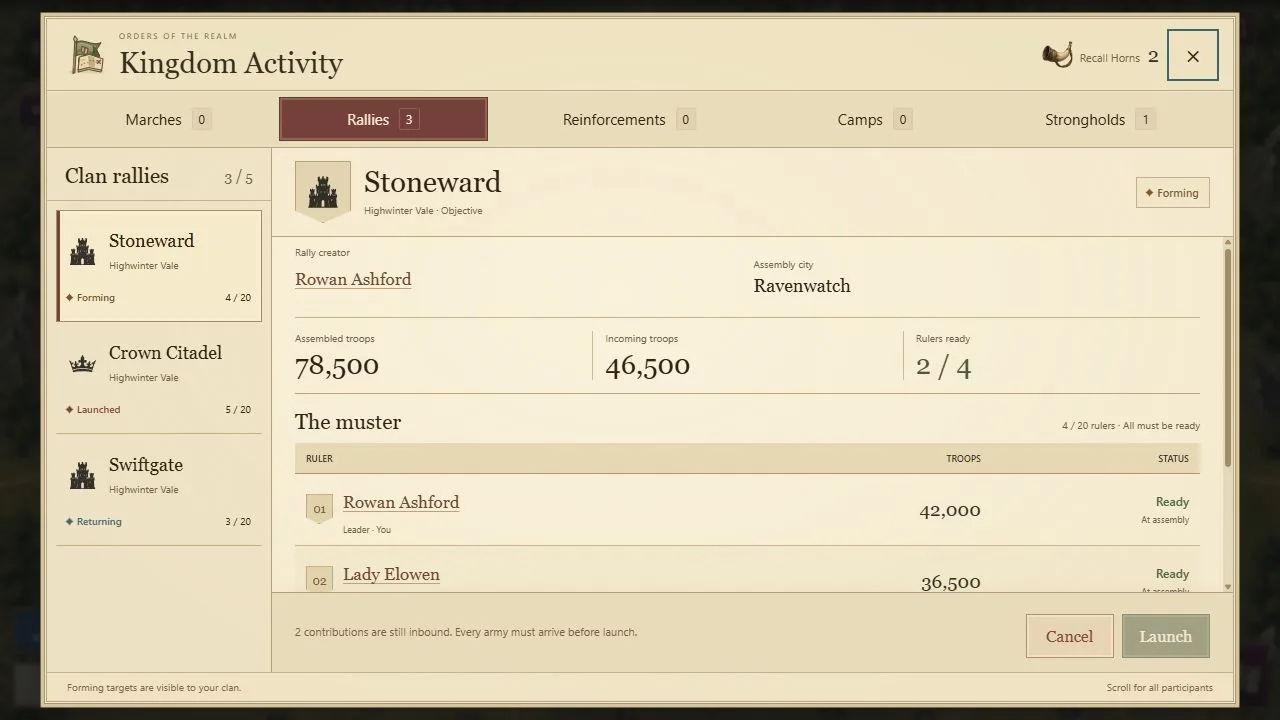
- 1The assembly city is where contributors gather.
- 2Readiness is tracked separately from troop totals.
- 3Launch waits until the rally’s requirements are met.
Select the image, then choose View full size to inspect details. Scroll or swipe inside the enlarged image.
Roles control coordination, not personal kingdoms
Clan leaders and officers can review applications, manage permitted roles, and remove members. Leaders and officers may form rallies. Every member can inspect the current rally state and use the controls allowed by their participant status.
Membership creates allied relationships on the map. Clanmates cannot treat allied cities as normal enemy targets. They can instead reinforce eligible holdings, coordinate objective control, compare progress, and communicate through the clan systems and the War Room.
Leadership is most useful when responsibility is explicit: who owns the objective plan, who can supply nearby support, which cities must remain defended, and when an operation is no longer worth additional troops.
Reinforcements join the garrison behind one wall
A reinforcement march transfers troops to an allied eligible holding without changing their owner. In a city or objective siege, those troops join the combined garrison and use their sender's applicable live soldier-defense package. They do not create an extra wall, copy Stoneworks, or adopt the holding owner's skill allocation.
Reward camps are different. They have no wall or level, and every stationed or reinforcing troop contributes exactly 1.00 defense power. Skills and objective support do not change camp defenders.
Swipe across the table to see every column.
| Holding | Reinforcement defense | Wall behavior |
|---|---|---|
| Regular city | Sender's eligible soldier-defense package | Shares the city's one wall |
| Stronghold or Citadel | Sender's eligible soldier defense plus current objective rules | Shares the objective's one wall |
| Reward camp | Exactly 1.00 per troop | No wall exists |
Assignments reserve capacity while troops travel
Each ruler may maintain two reinforcement assignments with each clanmate, limited to one contribution per holding. An ordinary city reserves at most five reinforcement contributors. That reservation begins when the support march launches, so a slow inbound march still occupies a contributor slot.
Allied Strongholds and reward camps do not use the ordinary city's five-contributor limit. The per-clanmate assignment rules still provide a readable boundary for each pair of rulers.
Use capacity deliberately. A token reinforcement can occupy the same contributor slot as a meaningful defensive package. Before sending, compare travel time, the incoming threat, and whether another clanmate is better positioned to fill the limited city slot.
Survivors try to return to their source
The sender can recall stationed reinforcements. The holding owner can send allied troops home. Battle losses are applied while they defend the position. Surviving troops normally return to the exact city or Stronghold they originally left.
If that source holding has been captured before departure or before the return march arrives, the server redirects surviving troops to the sender's current Main City. Assignment capacity remains occupied until the return arrives unless no troops survived.
The War Room forms one combined objective attack
A Leader or Officer can form a Rally against an enemy Stronghold or the Crown Citadel. Any active clan member may join with one army from one city. Each Rally supports 2–20 participants, and a clan may maintain up to five active Rallies. There is no expiry or automatic launch timer.
- Select an eligible objective and choose Rally.
- Commit troops from an owned city or Stronghold.
- Open Clan → War Room or Kingdom Activity → Rallies.
- Review every participant and wait until each contribution says Ready.
- The creator or Clan Leader manually launches the complete force.
Forming Rally details and the final objective remain private to current clan members. Other players can still see contribution marches traveling toward the creator's assembly city. Committing troops does not remove an active Royal Peace Shield.
Every participant must be Ready
Members may withdraw before launch. Launch is blocked with an explanation if fewer than two participants remain, any contribution is still inbound, a member or source has become invalid, or the objective is no longer eligible and hostile. No contribution is silently turned around while the rest launch.
After launch, the combined force appears as one incoming attack and travels at the slowest participant's locked march speed. Every participant keeps that ruler's own attack skills, equipped gear and applicable bonuses. New rallies receive no Training Grounds attack bonus; already-launched snapshots retain their recorded values. Only the creator may spend a Recall Horn on the launched combined army. If the creator leaves, is removed from, or changes clans, the server recalls the whole Rally automatically.
Losses are divided proportionally by troops contributed. A defeated Rally has no surviving attackers. On victory, the creator controls the Stronghold or Citadel and the creator's survivors hold it; allied survivors become individually attributable reinforcements stationed there. Every participant receives the same Rally outcome with clearly labeled individual committed troops, losses, survivors, and attack power.
A practical Rally checklist
- Choose an objective whose bonus supports the clan's current problem.
- Set a clear manual launch condition.
- Confirm at least two participants and verify that every row says Ready.
- Remember that the slowest contribution sets the combined march speed.
- Keep enough local defense to survive the counterattack.
- Read the shared participant report as a team before repeating the plan.
Clan Towers use separate rules
The ordinary 2–20-member Rally rules above describe Strongholds and the Crown Citadel. Clan Towers are clan-owned objectives with a three-member minimum and Tower-specific eligibility. Read the Clan Tower and Treasury guide before planning one.
Gifts, weekly conquest and shared funds
Clan → Rewards separates Gold Gifts, Weekly Conquest and Treasury. Gifts and weekly progress have their own eligibility and claim controls; donating to the Treasury is a separate action and cannot be withdrawn. Inspect the displayed goal, reward and remaining allowance before promising resources.
Agree on a Tower funding plan with the clan. The Shop and Workshop guide explains which purchases use personal Gold and which projects use shared Treasury funds. Clan membership, identity and roles persist across seasons; seasonal goals, gifts activity, Treasury balance and objective ownership reset.
Put this system into practice
- Before your clan launches a rally — Check readiness, troop ownership, travel and target eligibility before the leader commits a shared attack.