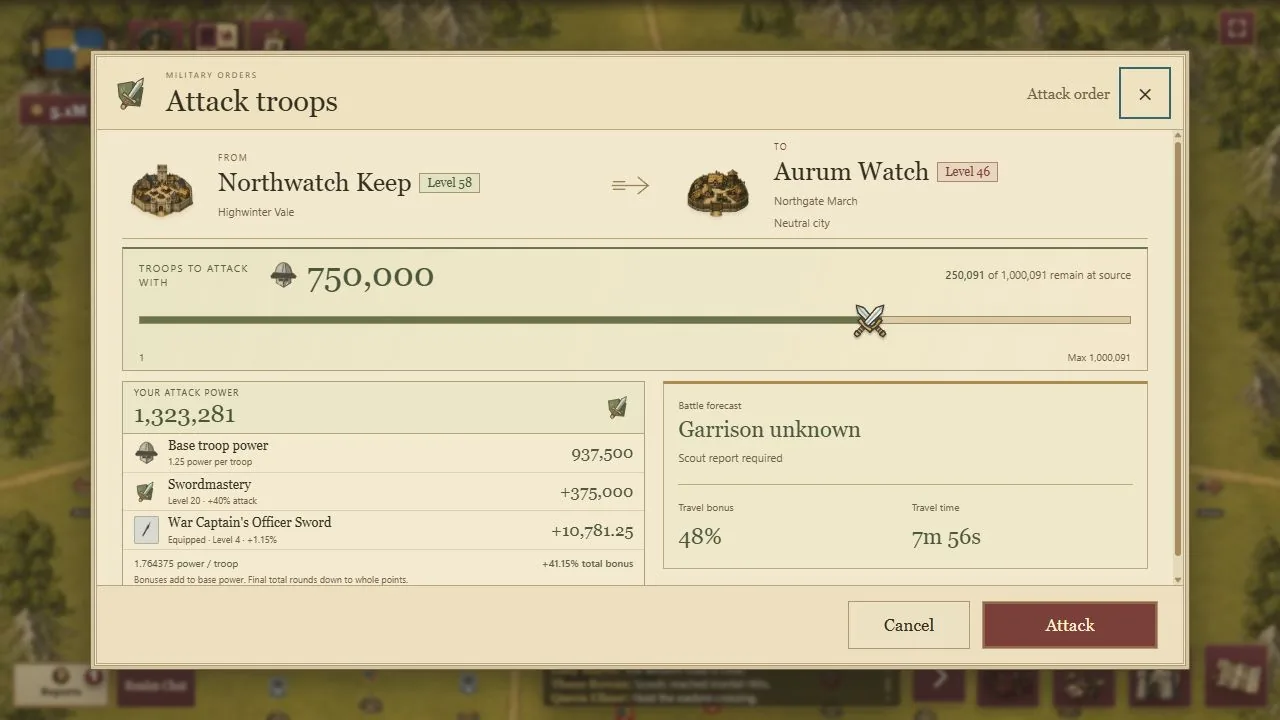

Identify the attack and its destination
Open Incoming Threats and distinguish an attack from a scout. Read the target city and arrival time. If you have just woken a phone or reconnected, allow the list and clock to refresh before planning around them. Missing intelligence remains unknown; a blank field is not evidence of a small army.
Open the threatened city itself. Your kingdom’s total troops include forces that may be elsewhere. For this defense, identify the stationed troops, wall condition and support that will actually be present when the attack arrives.
Count arrivals, not promises
Ask clanmates for help with the target and deadline clearly stated. A reinforcement march that arrives after the battle cannot protect the city in that battle. Read the journey for the selected origin and troop count instead of estimating from map distance.
Ordinary cities have five contributor slots, including reserved assignments. A ruler can maintain two assignments with each clanmate, with one per supported holding. A slot already committed by an incoming contribution can explain why another offer is rejected. Check the current reinforcement state rather than repeatedly sending the same order.
In an illustrative emergency, an ally arriving in eight minutes can help against an attack due in twelve; a twenty-minute route cannot. Those timings are examples, not fixed Crownlands travel limits.
Separate the wall from the soldiers
Combat spends attack power against the wall before resolving the garrison. A large wall and a large defending army address different parts of the fight. Check both, especially if this city was recently attacked or captured.
Defender skills and applicable gear are read from the live defensive state at arrival. An attacker’s committed bonuses are recorded at launch. Changing your defensive preparation can therefore matter, but a saved preset has no effect until applied. Read the Gold cost of Apply and confirm the active build afterward.
Read the protection requirements
A Royal Peace Shield runs for 12 hours and protects each owned regular city only while its walls are at 100%. A damaged city remains attackable, then gains protection automatically when repair finishes if the same ruler still owns it and the Shield is still active. Repair does not restart the item timer. The Shield cannot be renewed while already active. Player-targeted offensive actions also impose a 15-minute shield cooldown under the applicable rules. A shield item in your inventory is not proof that this city can use it now.
Read the action’s current eligibility message before relying on protection. A damaged city needs its repair deadline checked. Do not spend the remaining reaction time assuming a level upgrade will restore the wall or that a last-minute counterattack has no effect on shield eligibility.
Resolve the result before ordering again
At arrival, read the battle report and reopen the city. Confirm ownership, survivors and wall condition. A screen left open through the battle can be stale, and a victory can still leave an exposed garrison.
If you counterattack, scout the actual target and read the current restrictions. When a protected weaker ruler captures a stronger ruler’s regular city, the displaced ruler can receive one-use retaliation authorization for that exact lost city. The 30-minute window lifts its King Power attack limit, with other protections still applying; it does not authorize attacks on every city belonging to the capturer. Keep the report and target straight, then plan the next move from the confirmed result.