
1

Begin a kingdom

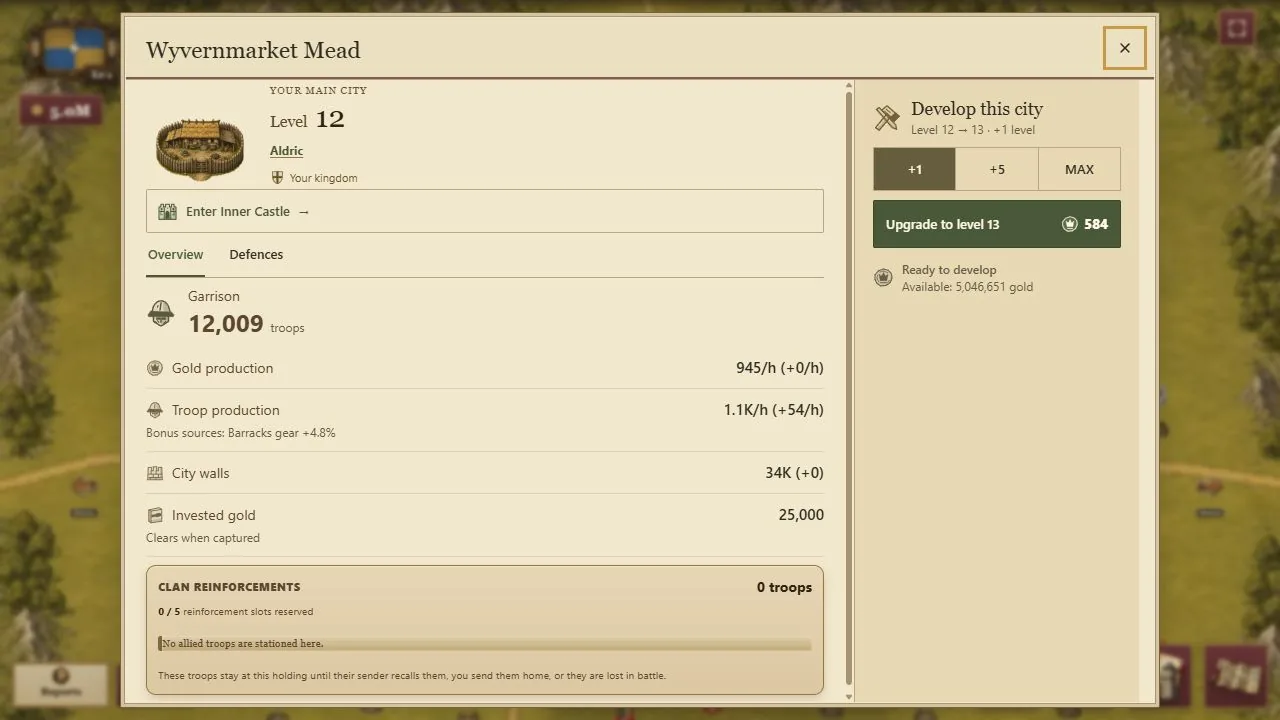
Sign in with Google, choose The Crown Marches, and enter the shared realm. A new ruler claims an available starting city in a starter region. That city becomes the main city: the default rally point for certain returned troops, recovered losses, and rewards that need a stable destination.

The opening goal is not to attack every nearby marker. First identify the main city, its current troop count, the rate at which it produces gold and troops, and the neutral cities within practical marching distance.

2

Build production deliberately

Regular cities produce gold and troops in real time. Higher city levels create more victory points, which increase production and make the city more valuable. Upgrading costs gold, so each upgrade is a choice between stronger future income and keeping resources available for immediate actions.

Each city produces 10 troops per victory point per hour before bonuses. Gold uses its separate city-production curve. Royal Granaries and Tax Stewardship improve those base rates, while Stronghold, Citadel, and timed-item percentages are shown separately so the Economy and city detail panels explain exactly where each total comes from.

Victory points measure city value and drive base troop production; they do not directly strengthen one attacking soldier, and passive gold does not use VP. Open the interactive Battle and Economy Guide to compare city levels, production, walls, skills, and battle thresholds.

Active-map pickups appear every three minutes and alternate between one hour of stored gold production and one hour of stored troop production. The daily limits are 25 of each type, 50 total. Daily login rewards use the current UTC calendar month; missing a day pauses progress, up to two earned rewards can wait, and unclaimed rewards expire at the next month rollover.

Open Daily Rewards and choose the Quests tab to see three Daily Missions. They reset at 00:00 UTC and are scaled from a server snapshot of the kingdom’s current production, cities, troops, and available activities, so their targets and rewards do not move during the day. Progress comes from validated gameplay. Claim each completed reward manually, or use the one daily reroll to replace an unfinished mission and discard its progress.

Troops remain in the city that produced them until they march. That means a productive city can become a useful defensive reserve, but only if its troops are not repeatedly drained. Gold is held at the kingdom level and can be used across the realm.

Useful habits

  • Upgrade safer interior cities when the border is unstable.
  • Keep enough troops in exposed cities to discourage easy captures.
  • Use the owned-city list to compare levels, troops, and regions instead of searching every map manually.
  • Review production after gaining or losing cities because kingdom totals can change immediately.
3

Read the regional map

Crownlands is divided into connected island regions. Edge connections move the view between neighboring regions, and armies follow valid routes across those connections. Cities, camps, Strongholds, and the Crown Citadel appear as interactive markers over the map.

Select an owned city to review its troops, level, production, and available actions. Select a neutral or rival city to see scouting, attack, and information options. The home indicator recenters the view when the main city is outside the current screen.

4

Scout before attacking

A scout is a small march that reveals a snapshot of a target after arrival. The report shows the holding owner's garrison separately from each clan member's stationed reinforcements, plus exact current wall integrity, wall power, garrison power, and relevant bonuses. Successful intelligence lasts for ten minutes from arrival, then its entry is removed from Reports. A newer successful scout replaces that target's report and restarts the timer; failed or blocked scouts do not refresh it. Attack and defense reports remain available for 24 hours after combat. Scout Nearby charges its displayed kingdom cost once and either launches every confirmed one-troop scout or launches none.

Use the combat forecast together with the latest report. It shows how much attack power the wall is expected to absorb and how much should reach the garrison. It separately labels a likely wall hold, garrison hold, capture, protected breach, or protected raid, and shows projected losses, the report age, estimated survivors, the minimum force needed to capture, and any shortfall. Advantage labels are intentionally conservative: overwhelming requires at least three times the live resolved defense.

Your army’s per-troop attack power is fixed when it launches. Defense stays live until arrival: troop production continues, reinforcements may arrive or leave, damaged walls may repair, objective bonuses can change, and ownership may change. The detailed battle report compares the launch forecast with the live arrival result so a changed outcome can be explained.

Do not send based only on the number printed over a city. Walls, skills, Stronghold effects, allied reinforcements, and recent troop movement can change the actual defense.
5

Send armies and protect holdings

Choose a source city, target, and troop amount to create a march. The server calculates and validates the authoritative route and arrival time together with ownership, available troops, protection rules, and other requirements before accepting the order. Regroup also runs as one server-validated batch: its displayed cost is charged only if every confirmed nearby transfer is created. When a march arrives, the server resolves the outcome and records a report.

Successful captures transfer the city and reduce its level by one, never below Level 1. Failed attacks can still award reduced experience. Newly acquired cities remain immediately attackable and award their normal battle and capture experience.

Defense happens in two layers

Attack power strikes the holding’s one physical wall first. If the wall is not breached, it absorbs the assault and defender troop losses are capped at 10%. If it is breached, only the remaining attack power fights the garrison; the city is captured only when that remaining power exceeds garrison defense. Each defender uses 1.30 base power, plus Shieldwall Discipline and additive personal or shared clan objective support. City level never increases soldier defense. Stoneworks alone strengthens the wall.

Each level’s full-breach repair window is 15 minutes plus 0.3 minutes per city level, rounded to the nearest minute with no cap. A hit that removes at least 5% of full wall power persists and adds its exact damage share of that window: a 20% hit adds 20% of the full-breach time. Wall integrity and defensive power then rise continuously while the repair timer counts down, reaching 100% at the deadline. Another meaningful hit applies to the wall’s recovered strength, keeps elapsed repair progress, and adds only its own damage time. Combat captures and every player or neutral handoff preserve the damaged integrity and running deadline, and a capture level drop does not recalculate it. Reinforcements help the garrison but do not add duplicate walls. Protected raids never persist wall damage. If an attack is already marching, decide whether to reinforce, counterattack while a wall is damaged, move vulnerable troops, or preserve resources elsewhere.

6

Contest camps, Strongholds, and the Citadel

Resource camps reward a ruler who defeats their defenders and holds the position for the required time. Every neutral camp starts with 20,000 troops. Camps have no level or walls, and each stationed troop contributes exactly 1.00 defense power without skill or objective bonuses. Gold and troop camps provide production-based rewards, while Deed and Relic camps use their own award rules. Camps are temporary objectives rather than ordinary permanent cities.

Strongholds grant strategic benefits to their controller. Different Strongholds can improve gold, training, defending-soldier power, or movement. Defense Stronghold and Crown Citadel percentages apply only against each defending soldier’s 1.30 base; they never increase walls, Stoneworks, city level, or repair time. The Crown Citadel is the realm’s central prestige objective: its current controller receives the Citadel effect, and the Reign Ledger records cumulative control time.

7

Develop skills and use items with purpose

Hero levels award skill points. Skills are grouped by role: Attack contains Swordmastery, March Orders, and Field Medics; Defense contains Shieldwall Discipline and Stoneworks; Utility contains Tax Stewardship, Royal Granaries, and Guild Charters. Shieldwall Discipline adds 2% soldier defense per level up to 60%; Stoneworks remains separate and affects only walls. These groups organize the screen but do not limit how you combine skills.

Four private skill-preset tabs unlock at Hero Levels 25, 50, 75, and 100. Rename an unlocked tab and use Save Current Build to store the exact eight-skill allocation in it. Only the most recently saved or applied matching tab is marked active, even when two presets contain the same allocation. Every confirmed Apply costs 1,000,000 gold, including an active preset or an allocation that already matches. Selecting, inspecting, renaming, saving, and overwriting tabs remain free. Existing Shieldwall rollout credits apply only to Reset Skills and are never consumed by presets. Skill points earned after saving stay available and unspent when that older preset is applied. Spending a skill point or using Reset Skills clears the active marker without changing saved presets.

Shop and reward items provide temporary protection, production, concealment, faster transfers, or army recall. Most items are bought with in-game gold and have daily limits. Read the description and duration before use; a timed effect is most valuable when it supports a planned sequence of actions.

8

Coordinate through a clan

Clans provide a shared identity, membership roles, applications, allied map information, shared rewards, and coordinated attacks. Clan members cannot treat allied cities as ordinary enemy targets. Instead, they can send reinforcements to eligible allied holdings.

Reinforcement troops continue to belong to their sender. In city and objective sieges they join the garrison with their applicable troop-defense bonuses behind the holding’s one physical wall. They do not create extra wall layers or duplicate Stoneworks. At reward camps, reinforcement skills do not apply; every added troop contributes exactly 1.00 defense power and there is no wall layer. You may maintain up to two assignments with each clanmate, but each assignment must support a different holding. Ordinary cities reserve up to five reinforcement contributors as soon as their marches launch; allied Strongholds and reward camps do not use this city limit.

The sender may recall stationed troops, the holding owner may send them home, and battle losses are applied when the position is attacked. Troops return to the city or Stronghold they originally left while it remains owned by the sender. If that holding has been captured before the return begins or while the troops are marching, the server redirects survivors to the sender’s current Main City.

Coordinate rallies in the War Room

Open Clan → War Room to manage clan rallies. Leaders and officers can form them; all members can join, inspect, or withdraw. The rally leader controls launch and cancellation.

Form and join rallies

Clan leaders and officers may form one rally against a Stronghold, the Crown Citadel, or a reward camp. Select the objective and choose Rally, then commit troops from an owned city or Stronghold. A rally holds up to three rulers: the rally leader and two allies. There is no launch timer; only the rally leader decides when to launch or cancel.

Rally details and the final objective stay private to current clan members while the force forms. Other rulers can still see allied contribution marches traveling to the leader’s assembly city. Committing troops immediately removes the contributor’s Royal Peace Shield, and cancelling or withdrawing does not restore it.

Open Clan → War Room or Kingdom Activity → Rallies to check participant slots, assembled and inbound troop totals, and arrival times. Allies may withdraw before launch. If the leader launches while a contribution is still inbound, that contribution turns around automatically and does not join the attack.

Once launched, the combined force appears as a normal incoming attack and the defender can see its objective. The rally uses the leader’s march bonuses while each participant keeps their snapshotted attack strength for combat. Only the leader may spend one Recall Horn to recall the combined army. After battle or recall, allied survivors march back to their source city, or to their main city if the source is no longer available.

First-session checklist

  • Locate the main city and review its production.
  • Identify two or three nearby neutral cities rather than spreading in every direction.
  • Upgrade where the resulting production will matter most.
  • Scout uncertain targets and read the resulting report.
  • Keep a defensive reserve instead of marching every troop.
  • Open the reports panel after each arrival to understand the result.
  • Review skills only after deciding whether the kingdom needs economy, defense, or mobility first.