

Start here
- Open Skills and inspect the current build.
- Choose attack, defense, or utility for your plan.
- Save a preset before changing to another strategy.
Common mistake: A saved preset has no effect until it is applied.
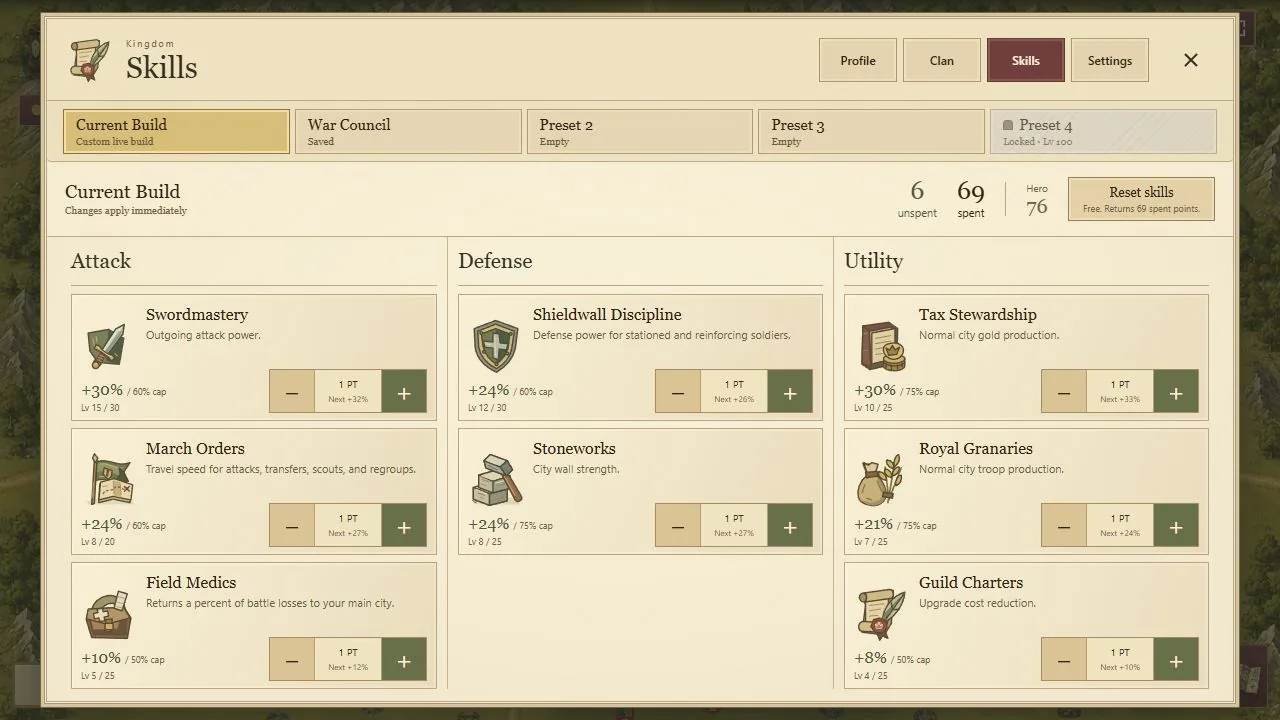
- 1Saved presets are separate from the Current Build.
- 2Unspent points are available for the active build.
- 3Defense skills identify which part of defense they improve.
Select the image, then choose View full size to inspect details. Scroll or swipe inside the enlarged image.
Eight skills, three readable groups
Hero levels award skill points. Crownlands displays those points in Attack, Defense, and Utility groups so the effect of each choice is easy to locate. The groups do not restrict mixed builds, and a saved preset can contain any legal combination of all eight skills.
The useful distinction is not “offense versus economy” in the abstract. Ask where the bonus resolves. Swordmastery is locked into an outgoing army. Shieldwall is read from the live defender. Stoneworks affects a holding's one physical wall. Production skills increase the underlying economy rather than troop power in a battle report.
Swipe across the table to see every column.
| Group | Skills | Strategic question |
|---|---|---|
| Attack | Swordmastery, March Orders, Field Medics | How hard, how quickly, and with how much recovery do armies operate? |
| Defense | Shieldwall Discipline, Stoneworks | How resilient are stationed soldiers and the physical wall? |
| Utility | Tax Stewardship, Royal Granaries, Guild Charters | How quickly does the kingdom fund, train, and improve its holdings? |
Attack skills shape a campaign beyond one number
Swordmastery
Every attacking soldier begins with 1.25 power. Swordmastery adds two percent per level, up to 100%, raising skill-only attack to 2.50 per troop. The value is captured when an army launches, so applying an attack preset after departure does not change that march.
March Orders
Faster travel reduces the defender's reaction window and helps a kingdom move between regional opportunities. Speed is valuable only when the route and destination still make sense; arriving quickly with too little capture power is still a loss.
Field Medics
Field Medics returns a share of eligible attacker losses after battle. Returned troops are shown separately in reports because they were lost during resolution and recovered afterward. This skill improves the sustainability of repeated operations, not the power that strikes the wall.
Do not combine soldier defense and wall strength
Shieldwall Discipline
Each defender begins with 1.30 soldier defense. Shieldwall adds 3% per point, reaching exactly 100% at 34 points. Eligible personal and shared objective support adds against the same base. City level does not increase soldier defense.
Stoneworks
Stoneworks is the only skill that increases wall power. A Stronghold, Citadel, allied reinforcement, or higher troop total cannot duplicate it. That separation makes defensive planning clear: Shieldwall protects the soldiers behind the breach point; Stoneworks increases the power an attacker must spend before reaching them.
Utility skills compound across a connected realm
Tax Stewardship and Royal Granaries
These skills improve passive gold and troop production. Their value grows with the number and quality of cities a ruler can hold. A pure production allocation can accelerate upgrades and replace losses, but it also leaves fewer points available for the battles that protect those producers.
Guild Charters
Upgrade efficiency matters when a kingdom is converting a large gold reserve into city levels. It is most useful when there is a deliberate upgrade plan rather than when points are moved simply because gold is temporarily low.
Utility strength is visible over hours and days instead of one report. Compare production before and after an allocation, then evaluate whether the additional income offsets the combat or defensive power that was not selected.
Presets store allocations; applying one is a real decision
Four private preset slots unlock at Hero Levels 25, 50, 75, and 100. Selecting, inspecting, saving, renaming, or overwriting an unlocked tab is free. Saving records the exact allocation currently shown across all eight skills.
Every confirmed Apply costs one hour of your raw regular-city gold production, including an active preset or a saved allocation identical to the current build. Apply moves the active marker to that tab. A preset saved before later hero levels does not invent an allocation for newly earned points; those points remain unspent when the older preset is applied.
Spending a point manually or using Reset Skills clears the active marker without overwriting saved tabs. Reset Skills and individual point refunds are free. Applying a saved preset is a separate paid operation; read its confirmation before proceeding.
- Select an unlocked tab and give it a name that describes its purpose.
- Edit the isolated preset draft and choose Save; the live build stays unchanged until Apply.
- Inspect the stored eight-skill allocation before a future Apply.
- Confirm the displayed gold cost only when the strategic change is worth it.
Three planning examples
Border defense
Prioritize Shieldwall and Stoneworks when exposed holdings need time for clan reinforcements. Keep enough economy to replace ordinary losses.
Objective pressure
Combine Swordmastery and March Orders when timing a Stronghold or Citadel operation. Field Medics supports repeated attempts but does not create capture power.
Realm growth
Lean into production and upgrade efficiency when the map is stable and the kingdom can protect its expanding economy.
Flexible ruler
Use mixed points for daily play and reserve unlocked presets for costly, deliberate shifts before major operations.
These are decision patterns, not mandatory builds. The correct allocation depends on the cities, travel distances, clan coverage, and objectives that exist in the live realm.
Skill rates and point costs
Hero Level 1 begins with zero points; each later level awards one. Every skill level costs one point. The last point in a 3%-per-point skill reaches exactly 100%, rather than 102%. All eight skills together cost 256 points, available at Hero Level 257.
Swipe across the table to see every column.
| Skill | Bonus per point | Maximum | Points to maximum |
|---|---|---|---|
| Swordmastery | 2% | 100% | 50 |
| March Orders | 5% | 100% | 20 |
| Field Medics | 2% | 50% | 25 |
| Shieldwall Discipline | 3% | 100% | 34 |
| Stoneworks | 3% | 100% | 34 |
| Tax Stewardship | 3% | 100% | 34 |
| Royal Granaries | 3% | 100% | 34 |
| Guild Charters | 2% cost reduction | 50% | 25 |
Skill caps differ from combined skill-and-equipment caps. Read the gear bonus reference when comparing complete builds. Hero XP, levels, points, upgrades and saved presets reset each season.
Put this system into practice
- Save a skill plan without changing the wrong build — Keep the active allocation, an edited draft and a saved preset distinct, then decide when a paid Apply is worthwhile.